
Effective vibration monitoring for reciprocating compressors
Modern standards require frame sensors and more
Reciprocating compressors show the highest number of damages while being process-critical at the same time. The reasons why are partially based on the higher number of centrifugal machines in comparison to reciprocating compressors, and operators just did not fear severe damages due to the lower kinetic energy of these comparably slow-running machines. Insufficient protection and condition monitoring principles are still being applied on some reciprocating machinery.
Inadequate machinery protection
At all times, operators, engineering procurement and construction companies (EPCs) and original equipment manufacturers (OEMs) have followed the existing, applicable guidelines and standards during the final engineering stage.
However, upon reviewing the age of the reciprocating compressor population, one will recognize that, in many cases, these large, critical machines have never been replaced and they have been in operation since their initial startup date many decades ago.
To understand why, even after numerous catastrophic failures, we still find inadequate machinery protection on many of these machines, a view into the history of applicable standards can help to lift the fog.
Crosshead acceleration as a safety shutdown parameter
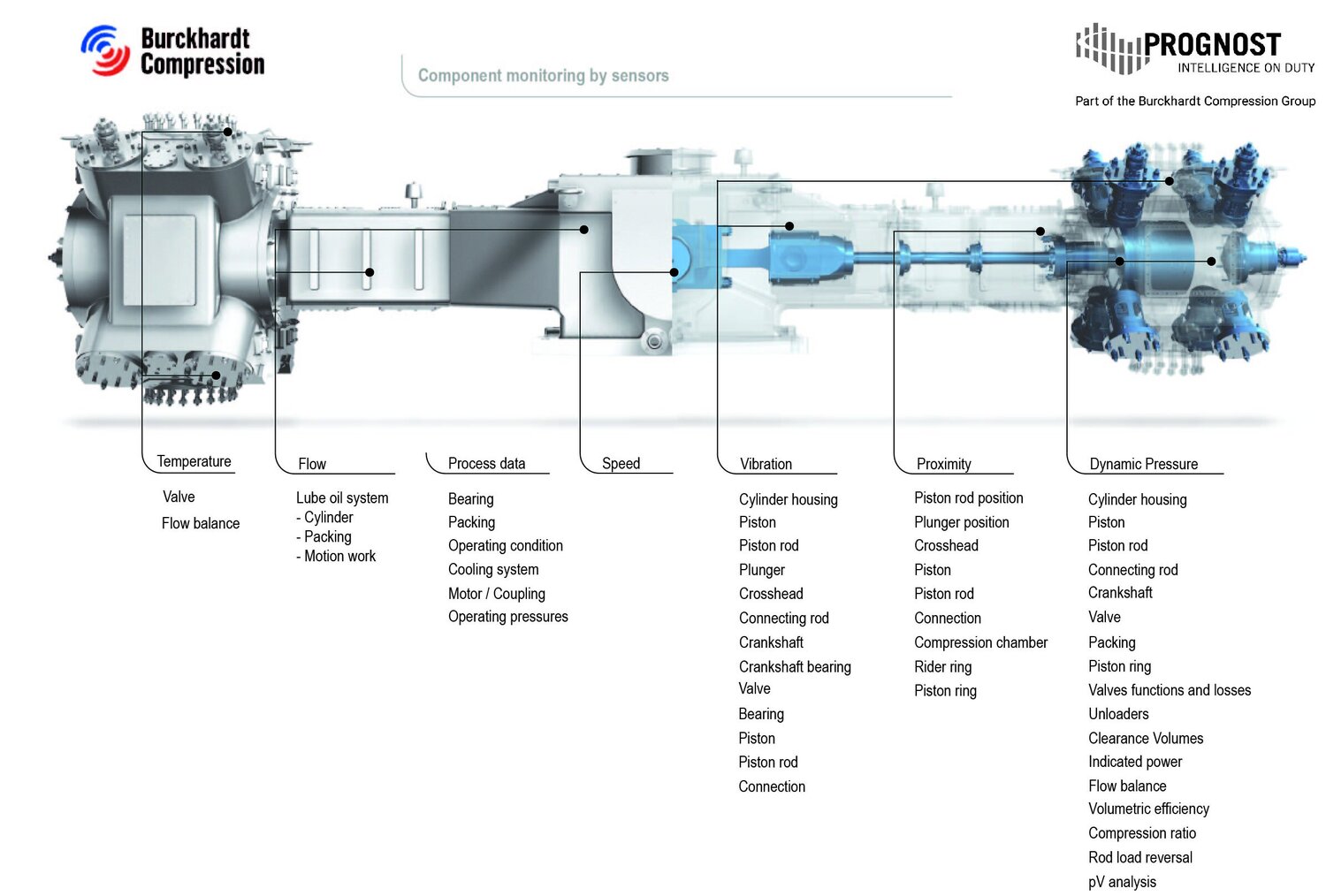
The API 670 fifth edition, released in November 2014, offers valuable information and guidance on how to effectively protect reciprocating compressors. Users and machinery protection system vendors have agreed upon the inclusion of applying crosshead acceleration as a safety shutdown parameter, which is a pivotal decision. API 670 is the central document for machinery protection of reciprocating compressors. Piston rod position measurement as a reliable second layer of protection is also recommended.
Frame vibrations measured as velocity, and piston rod
Numerous reciprocating compressors are equipped with machinery protection systems originally designed for centrifugal machinery. Two of the most widely adopted approaches that can often be found on aged reciprocating machinery are frame vibrations, measured as velocity, and piston rod position measurement.
Many compressor operators confirm the inadequacy of these outdated systems to protect against the most-feared compressor damages, such as breaking piston rods, seizing wrist pins and other failure modes involving loss of containment in some cases. While old-school systems often miss detecting the development of catastrophic damages in time or at all, users regularly report about a history of nuisance trips due to transient process peaks or single-time, uncritical impacts.
Consequentially, operators often consider disarming their outdated protection system and putting their trust in proven maintenance practices and relying on the sturdy machine design. It is importand to understand the difference between a uniform rotating movement of a turbine shaft in comparison to a reciprocating movement. Machines with a uniform rotation typically show almost zero shaft deflection per cycle along with a solid, stiff connection to the ground and virtually no frame vibration detectable.
The crosshead is clearly the focal point
In contrast, a reciprocating compressor shows a very different behavior, requiring a different monitoring approach. Pistons are driven back and forth by crosshead-type drive trains, involving reversal of piston rod forces from tension into compression, making the entire frame with all its components shake and bend to a good degree. Suction and discharge valves create opening and closing impacts, leaving vibration amplitudes on the entire machine – and we call this a normal operating condition.
When comparing the working principles of a reciprocating compressor with a centrifugal machine, it becomes apparent that a reciprocating unit requires a more dedicated monitoring approach designed to handle all the special challenges reciprocating machinery bears.
Looking at the working principal of reciprocating machines, the crosshead is clearly the focal point. Here, the rotating movement of the crankshaft is transformed into a reciprocating (linear) movement of the piston rod. It is the central component where all the major forces are transferred via the rather sophisticated crosshead pin/wrist pin to the piston rod. In order to facilitate these forces into the right direction, a solid crosshead guide is an integral part of each reciprocating compressor. The crosshead guide is the most direct connection of the moving drive train to the frame and is the best position to install vibration sensors.